How to Choose a B2B Data Provider (and Test One First)
A B2B data provider sells business contact and company records: names, titles, work emails, phone numbers, company size, industry. Every one of them will tell you its database is huge and its accuracy is high. Lusha, for example, advertises 515M+ contacts and 98% email accuracy on its data page.
We work on the checking side of this market. ProspectDesk resolves anonymous website visitors to real people and verifies each one before outreach goes out, so we see what happens to records after the homepage numbers have done their job. This guide shows you how to check those numbers yourself instead of adding another one to the pile.
Why the big numbers don't help you
Database size is a count of rows. It says nothing about whether the rows you need are in there, or whether they're current.
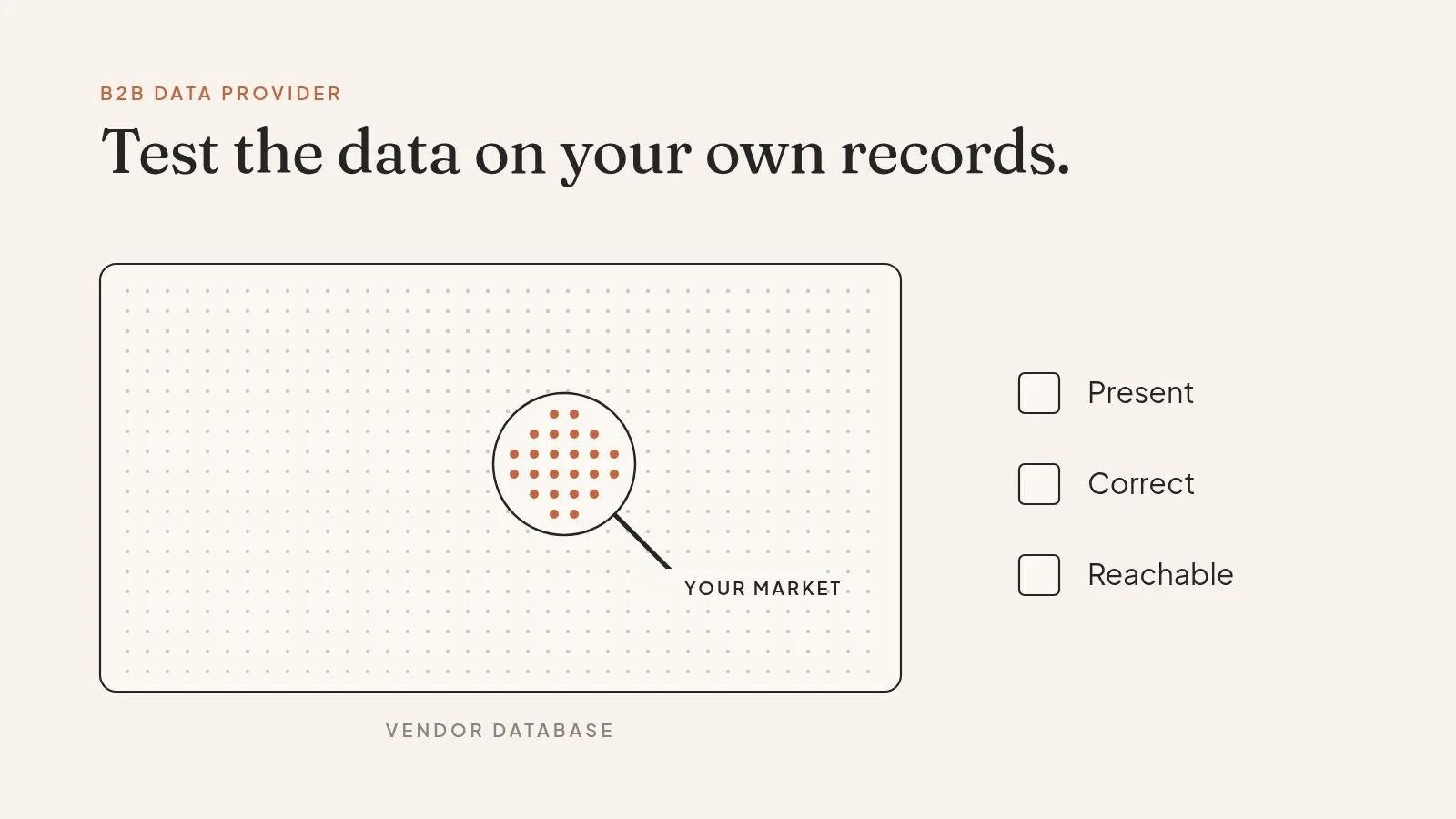
Think about what you actually buy. If you sell to US manufacturers with 50 to 500 employees, most of a 515-million-contact database is irrelevant to you. What matters is how many of the few thousand people in your market are present, correct, and reachable.
Accuracy claims have the same problem. A "98% email accuracy" figure is measured on a sample, under a definition, chosen by the vendor. InboundLabs, citing a July 2026 Cleanlist/G2 analysis, says self-reported vendor accuracy runs 15 to 25 points higher than what buyers measure in blind tests (InboundLabs). We can't vouch for that exact range, but the direction matches what anyone who has run a vendor bake-off learns: the vendor picks the test.
What a data provider can't tell you
Most providers are good at "who exists and how do I reach them." Getcleed's 2026 roundup puts it bluntly: none of them answers "who is buying this quarter" (Getcleed).
Two more blind spots catch buyers out.
People move. A record can be right the day it's collected and wrong three months later. Ask every provider how it detects a job change and how fast that change reaches your export.
An email that existed isn't an email that works. Catch-all domains accept everything at the server, so a basic check can't tell a real inbox from a dead one. Many providers count those as "valid." Your bounce rate finds out later.
The test we'd run if we were buying
Every serious comparison ends with "test it on your own list." Few explain how, and a loose test is easy for a vendor to win.
Build the sample yourself
Pull 100 to 200 records from your real target market. Include accounts you've already worked, so you know the right answers. Don't let the vendor pick, and don't send a list of famous companies. Coverage of Salesforce employees tells you nothing about a 120-person freight broker.
Keep a holdout
Send the vendor names and companies only. Keep the emails, titles, and phone numbers you already know, and compare their answers to yours.
Score four things separately
- Coverage. How many of your people did they return at all?
- Correctness. Of those, how many have the right current company and title?
- Reachability. Run every returned email through an independent email verification API. Count valid, invalid, and catch-all on separate lines.
- Freshness. For people you know changed jobs recently, did the provider catch it?

Watch for a cleaned-up trial
Vendors sometimes hand-clean a trial sample. Ask whether trial data comes from the same pipeline as production exports, and what changes when you move from trial to contract.
Split results by segment
A provider can be strong for US tech and weak for European manufacturing. If you sell into both, score them separately. A blended figure hides the weak spot until you've paid for it.
The providers buyers usually shortlist
Most comparison articles for this search cover the same names, and most are written by vendors who rank themselves first. That's normal, and worth remembering as you read them. Here's what vendors and public sources say, so you know what you're testing. None of these are our numbers.
| Provider | Usually picked for | Public pricing signal | What to test hardest |
|---|---|---|---|
| ZoomInfo | Enterprise teams that call | No list price; Vendr median $33,500/yr across 1,581 purchases (Vendr) | Freshness in your segment, contract terms |
| Cognism | EU and UK teams that need compliant mobiles | No list price; Vendr median $32,750/yr across 94 purchases (via Supered) | Coverage outside EMEA |
| Apollo | Self-serve outbound for small teams | $49 to $119 per seat per month billed annually; $65 and $99 monthly on Basic and Professional (Apollo) | Email accuracy on catch-all domains |
| Lusha | Quick contact lookups | Claims 515M+ contacts and 98% email accuracy (Lusha) | Whether the accuracy holds on your list |
| RocketReach | Early teams on a small budget | $27 to $142 a month, per Demandbase's roundup (Demandbase) | Phone coverage, title freshness |
| Bombora | Account-level intent | Custom pricing, per Demandbase's roundup | Whether intent maps to people you can reach |
Use the table to pick three to trial. Then let the test decide.
Pricing models, and where each one bites
Prices in this market fall into three rough groups.
Per-seat or per-credit tools. You pay a monthly fee for a set number of exports. Getcleed's roundup puts these from free to about $150 per user per month (Getcleed). They're easy to start. The catch is export caps and credits that run out mid-campaign.
Annual enterprise contracts. ZoomInfo and Cognism don't publish list prices; Vendr's purchase data puts both medians near $33,000 a year. You get depth and phone coverage. You also commit before you know your real usage.
API or usage-based pricing. You pay per matched record. This fits companies building data into a product, since cost scales with use. The risk is paying for matches that turn out to be the wrong person, so ask whether low-confidence matches are billed.
Whatever the model, work out one number yourself: the cost per verified, correct contact in your segment.
A made-up example of the math: a plan costs $1,000 for 2,000 exports, so 50 cents a contact. In your test, 80% of returned people were the right person at the right company, and 70% of their emails passed verification. Only 56% of what you pay for is usable, so each good contact really costs about 89 cents. Run the same math for every vendor you trial. The cheapest sticker price often loses.
Contact data, intent data, or both
The results for this search mix two kinds of seller. Apollo and most listicles sell contact records you can look up and export. Bombora sells intent: which companies are researching a topic right now.
They answer different questions. Contact data tells you who to reach. Intent tells you which accounts to reach first. Many teams buy them from different vendors and then struggle to join the two, because intent usually arrives at the company level and contacts arrive at the person level. If you need both, ask each vendor how its records connect to the other kind, and test that join on your own accounts.
Sourcing and compliance
Ask where the data comes from before you ask what it costs. Providers build databases from some mix of public web data, partner data, contributions from users of their own tools, and human research. Each source carries different rules.
If you sell into the EU or UK, you need a provider that can explain its lawful basis for processing and how people opt out. US buyers aren't off the hook either, as state privacy laws keep spreading. A badge row on the homepage is a start. A written answer about your regions, from someone willing to put their name on it, is better.
This matters more if the data sits inside a product you sell. Your customers will ask where it came from, and "our vendor said it was fine" won't hold up for long.
Are you buying a database, or a check?
Founders who need a list to email this week are usually well served by a self-serve database like Apollo or RocketReach. That's a sensible buy.
A different buyer lands on the same search: an agency or platform whose clients want to know who is on their website and whether those people are worth contacting. A database seat doesn't solve that. The people who matter most are often the ones who visited a pricing page and never filled in a form, and they aren't in any export you can download.
That's the problem ProspectDesk solves. We resolve anonymous website visitors to real people, then run a Know Your Prospect (KYP) check before any outreach goes out: is this a real person, matched to a specific identity; are they reachable, with a verified email; and are they ready, with a current in-market signal? Anyone who fails is held back. Partners white-label the whole thing and bill it as their own product, so it becomes a line item for them rather than another tool their clients have to buy. If you're mapping out the rest of the stack, read our data enrichment API guide next.

Questions to put to every vendor
- How do you detect job changes, and how long until they show up in my data?
- How do you treat catch-all emails, and do they count toward your accuracy figure?
- Is the trial data from the same pipeline as production?
- Am I billed for low-confidence matches?
- Where does the data come from, and can you document consent for my regions?
- What happens to my costs if my volume doubles?
A vendor who answers these plainly is worth a closer look.
Related guides
- People data API guide — the fields, match rules, and miss behavior of a person lookup.
- Data enrichment API guide — how enrichment matching works and what to check before you pick one.
- Email verification API guide — why a returned email isn't a sendable email, and how to handle catch-alls.
- Technographic data API guide — how tech-stack detection works and where it goes wrong.
Want to run the holdout test above against us? Book a call and bring your hardest 200 records. We'll show you which ones pass KYP, and which ones we'd hold back.
FAQ
What is a B2B data provider?
A company that sells business records: companies, people, contact details, technologies, or intent signals. The useful ones tell you when they don't know something, rather than filling the gap with a guess.
How do I test a B2B data provider before I buy?
Pull 100 to 200 records from your own market, including accounts where you already know the right answers. Send the vendor names and companies only, then score coverage, correctness, verified emails, and freshness separately.
Why can't I trust vendor accuracy claims?
Because each vendor chooses the sample, the definition of "accurate," and the test. A figure measured on the vendor's best segment says little about yours. Your own holdout test is the only number that applies to your market.
How much does a B2B data provider cost?
It depends on the model. Self-serve tools run from free to about $150 per user per month. Enterprise contracts at ZoomInfo and Cognism carry Vendr medians around $33,000 a year. Usage-based APIs charge per matched record. Compare cost per verified, correct contact, not sticker price.
Do I need contact data, intent data, or both?
Contact data tells you who to reach; intent tells you which accounts to reach first. If you buy both, test how the two join, because intent is usually company-level and contacts are person-level.