Buying Signals: How to Tell a Brand Is Ready to Hire Your Agency
Most agency new-business advice is about getting more names. More CMOs in a spreadsheet. More "just circling back" emails. More decks sent into a void.
That is the wrong problem. Agencies don't have a lead problem. They have a timing problem.
A buying signal is evidence that someone is actually considering a purchase, not just that they exist. Salesforce puts it plainly: buying signals are "subtle communication cues from prospects that indicate an interest in a product or service," and they can show up as a verbal commitment, an emailed question, or even body language in a meeting (Salesforce, 26 Sep 2023). Sales coach Richard Harris, quoted in that same piece, is blunter: you don't really know they're ready "until they tell you they're ready to buy, and you can't believe it until you get a signed contract." Until then, you look for "a strong indication of intent to purchase."
This guide is written for agency owners. It translates those sales ideas into the moments that mean a brand is getting ready to hire a firm like yours, and it draws a hard line between a signal you can act on this week and a data file that only says a company exists.
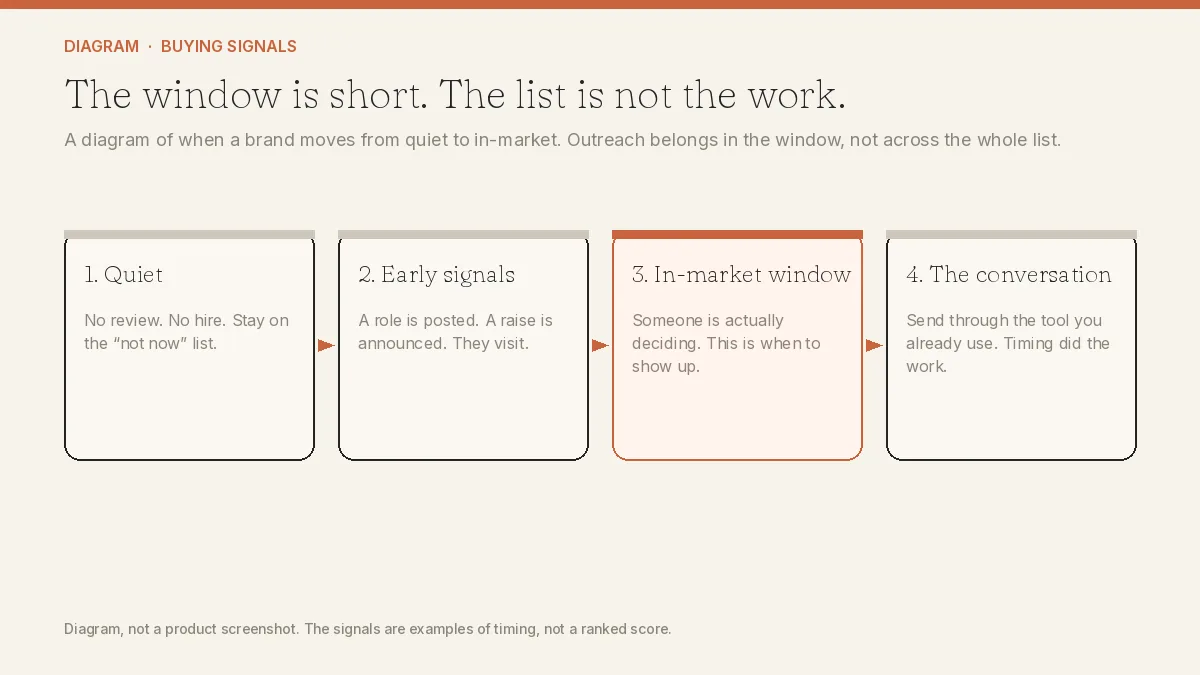
What a buying signal actually is
A buying signal is not a job title, and it is not a fit score. Fit tells you whether an account looks like your other clients. A signal tells you whether something is happening now.
HubSpot groups the common ones into a few practical types (HubSpot):
- Verbal signals. What a person says or writes: questions about pricing, implementation, next steps, or how you would work with their current stack.
- Non-verbal signals. What you can see or hear in a meeting: leaning in, taking notes, bringing a colleague, a change in pace.
- Digital signals. What they do when you aren't in the room: return visits to your site, case-study reads, pricing or contact-page views, repeated email opens and clicks.
Salesforce also talks about sales event triggers (sometimes called buyer signals or buyer intent data): points in time at a prospect's company that can open a conversation, including expansion, new funding, hiring or promotions, layoffs, mergers and acquisitions, and awards (Salesforce, What is Sales Intelligence?).
For an agency, the useful question is always the same: does this signal mean a marketing decision is in motion, or does it just mean someone is browsing?
The buying signals that matter when a brand hires an agency
The categories above were written for product sales. They still hold when the "product" is your firm. The examples change.
1. They start asking questions that only a serious buyer asks
Alexine Mudawar, CEO of Women in Sales, told Salesforce that "the highest close rates are among prospects who are very inquisitive," including questions that can sound negative, like why they would choose you over another option. That usually means they are already imagining implementation, not touring a capabilities deck (Salesforce).
In an agency conversation, those questions sound like: "What would a first 90 days look like?" "Who would actually be on the account?" "Can you work alongside our in-house team?" "What does a retainer cover versus a project?" They are not asking you to be interesting. They are testing whether they can hire you.
2. They introduce you to the people who can say yes
Harris's coaching question is simple: "Are they willing to give you a name and title? Are they getting you additional meetings?" Those are good signs (Salesforce).
If your first contact at a brand starts looping in a CMO, a founder, finance, or procurement, the deal has moved from "interesting chat" to an internal process. Treat that as a buying signal, and make it easy for them: a short written summary, a clear scope, and no theatrics.
3. The timeline speeds up, or a real deadline appears
Mudawar flags a stakeholder who starts "expediting timelines" or kicks off legal and procurement while you are still in evaluation. Harris asks what happens if a date they named passes without a decision. If there is a real consequence, the timeline is real (Salesforce).
Agency versions of this are everywhere: a campaign that has to be in market for a launch, a retailer window, a board meeting, a contract with an incumbent that is coming up for renewal. "We should talk sometime in Q2" is not a deadline. "We need a partner on this before the launch in March" is.
4. They are already on your site, more than once
Digital signals are often earlier than verbal ones, and they are the ones most agencies ignore because the visitor looks anonymous. A second visit to a case study in your category, time on a process page, a return to contact or pricing, or a visit from an account you already had a "not now" conversation with is closer to a hiring moment than a cold LinkedIn connection.
This is first-party intent: behavior on your site, about your work, happening right now. It is also the easiest signal to misread if you only see a company name and not the person. Our guides to website visitor identification software and website visitor tracking tools cover that distinction. The matching layer behind a name is identity resolution software.
5. The company itself is going through a change
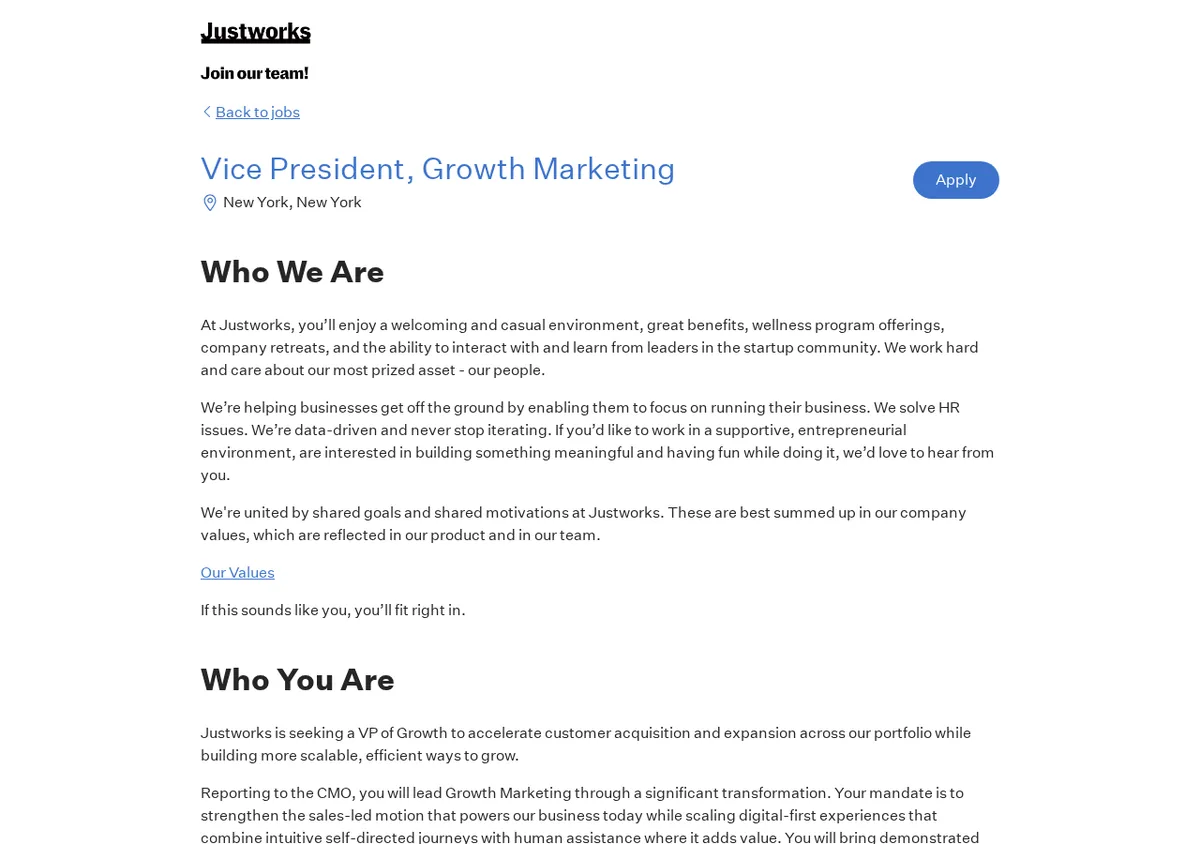
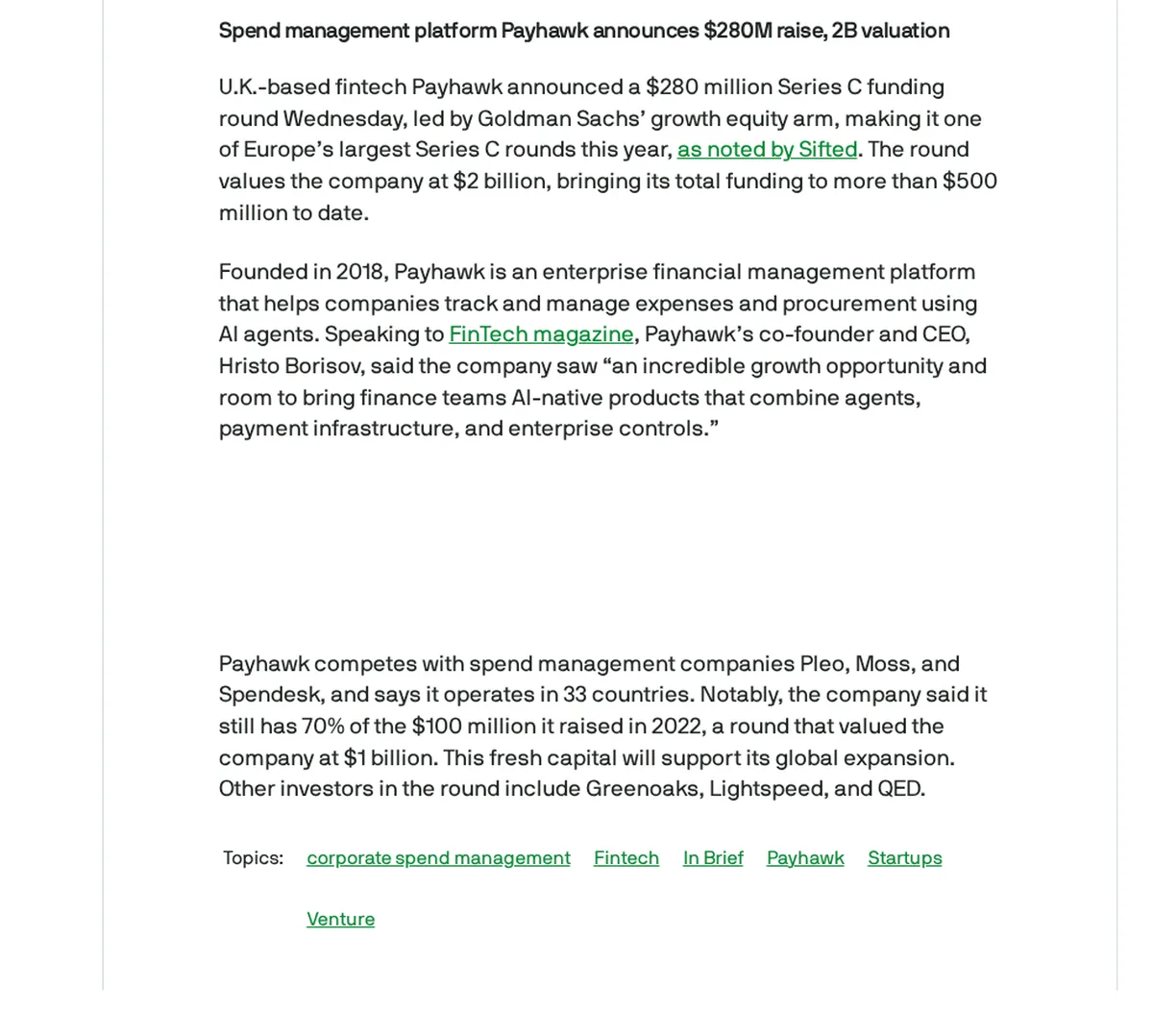
Salesforce's trigger list (funding, leadership changes, hiring, expansion, M&A) maps cleanly onto agency new business. A new CMO, a first in-house marketing hire, a product launch, a funding announcement, or a public comment about "bringing in a partner" are not guarantees. They are windows. The review often starts informally, long before an RFP is written.
The mistake is treating the announcement as the moment to pile on with a generic capabilities email. The useful move is to notice the window early, and to already be useful when the brief is being formed.
6. They tell you, clearly, that it is not now
This is a signal too, and most agencies waste it. "Not this quarter," "we just signed a year," or "we're handling this in-house for now" is not a dead lead. It is a timing mark. The account can come back. The agencies that win those later are the ones that stay close without nagging, and that notice when the "not now" starts to thaw: a new visit to the site, a leadership change, a contracted end date coming into view.
Signals that look like buying and often aren't
Not every spike is a hire. A few false friends:
- A single content visit. Someone reading a blog post is not in a review. Look for repeat, high-intent pages, or a pattern over a few days.
- A compliment in a meeting. "This is great work" is polite. "Can you send a statement of work?" is a signal.
- A spray of third-party 'intent' on a broad topic. Topic-level research at a company can be a student, a vendor, or a team in a different country. It is useful context, not a reason to blast the whole org. If you use third-party or review-site data, read B2B intent data providers for how those sources actually work, and keep that page for vendor selection. This article is about reading the moment, not picking a data file.
- A job title that 'looks like' a buyer. Fit is not timing. You already know plenty of CMOs. You need the ones who are in a decision.
Elyse Archer, quoted by Salesforce, follows back and asks what prompted a social follow within 24 hours, then checks whether the person actually fits the buyer profile (Salesforce). The follow is a door, not a close.
What to do when you see a real signal
Speed matters, but so does the quality of the first move.
- Name the signal in your notes. "Returned to the paid-social case study twice this week" is more useful than "hot."
- Reach the person, not just the account. An account-level spike without a name leads to a generic email that gets ignored. Person-level is slower to collect and much easier to act on.
- Write to the moment, not to your reel. If they are hiring ahead of a launch, talk about how you would staff the first 90 days. If they just brought marketing in-house, talk about where an outside team still fits, the way we do in the Duolingo marketing strategy teardown.
- Ask one clear next step. A 30-minute working session beats a 40-page deck.
- If they say not now, keep the date. Put a reminder on the contract end, the quarter they named, or the launch they mentioned. Then watch for the thaw.
This is also where most outbound tools fail agencies. Instantly, lemlist, Smartlead, Apollo, and the rest will send whatever you load, on whatever cadence you set. They are good at sending. They are not good at knowing whether this Tuesday is the Tuesday that matters. Use them to deliver the message. Let the signal decide when the message goes. If you are comparing sequencers, start with our Lemlist alternatives guide, and keep ProspectDesk in the stack as the timing layer, not as another inbox tool.
The same idea holds if you already use a visitor-identification or intent product. The intent targeting view is how we think about in-market accounts on your own traffic and research activity. The job is not a bigger list. The job is a shorter, better-timed one.
The timing lesson for agency owners
Agencies don't have a lead problem. They have a timing problem.
The firms that feel "busiest at new business" are often just the loudest. The firms that win are the ones who can see a buying signal while a decision is still open, and who are already slightly familiar when the brief hardens into a review. Wieden+Kennedy's Nike story is the long version of this: they were already in the room when the national decision got made. You will not get that from a purchased list of CMOs.
ProspectDesk is built for that moment. We are not a contact-data provider, and we are not trying to replace your sequencer, your CRM, or your referral muscle. We show you which companies are actually in-market right now, starting with the people already on your site and the accounts already showing intent, so outreach lands while a decision is still open.
If you want to see which of your prospects are in that window, book 30 minutes.
I've taken businesses from $0 to $2M three times, and I built DTC POD and Castmagic along the way. Every one of those runs taught the same lesson: the conversation you wanted was usually available earlier than your calendar said it was. You just had to notice.
FAQ
What are buying signals?
Buying signals are cues that a prospect is interested in buying, or is moving toward a decision. They can be verbal (questions about price, implementation, or next steps), non-verbal (bringing colleagues, leaning in, speeding up a process), digital (repeat visits to high-intent pages, email engagement), or trigger events at the company (a new leader, a funding round, a launch). Salesforce's definition is the one we use as a starting point (Salesforce).
What is the difference between a buying signal and intent data?
A buying signal is the thing you observe: a question, a visit, a deadline, a referral into the C-suite. Intent data is one way of collecting some of those signals, usually at the company or topic level, from a publisher network, a review site, or your own website. They overlap. They are not the same. For how providers collect intent, see B2B intent data providers.
What are examples of buying signals for an agency?
Questions about retainers, team makeup, or the first 90 days; an introduction to a CMO, founder, or procurement lead; a real launch or renewal deadline; repeat visits to your case studies or contact page; a new marketing leader or a public search for a partner; and a clear "not now" that later starts to thaw.
How do you act on a buying signal without being pushy?
Write to the specific moment you saw, reach the person who showed the interest, and ask for one concrete next step. If the timing is wrong, mark the date they gave you and watch for the next signal instead of forcing a close.
Do buying signals replace referrals?
No. Referrals are still how a lot of agencies win work. A referral is often a buying signal in disguise: someone is asking for a name because a decision is already in motion. The point of reading signals is to catch the same moment when the referral has not arrived yet.
Sources
- Salesforce, 5 Buying Signals Too Many Sellers Miss, 26 Sep 2023: definition; Harris, Mudawar, and Archer quotes; five missed signals
- Salesforce, What is Sales Intelligence?: sales event triggers (funding, hiring, M&A, expansion)
- HubSpot, Decoding Buying Signals in Sales: verbal, non-verbal, and digital types