How Marketing Agencies Get Clients (It's a Timing Problem)
Ask a room of agency owners how they get clients and you will hear the same first answer: referrals. Then, if you wait a beat, you will hear the second answer, usually quieter: it is getting harder, the pipeline is thinner than it looks, and outbound "sort of worked once."
Both things can be true. The agencies that keep growing are not the ones who abandoned referrals. They are the ones who stopped treating new business as a lead-volume problem and started treating it as a timing problem.
This is a practical guide for agency owners, built on what your peers have actually reported, not on a fantasy of infinite inbound.
What the surveys say about how agencies really win work
Two recent surveys are worth taking seriously, because they asked agencies themselves.
In January 2025, Paddy Moogan published results from a SparkToro survey of 612 agency owners and consultants. A "whopping 66%" said their top source of referrals for new business was existing and past clients. Referrals from partner companies were second, at nearly 13%. Outbound sales activity was the top source of new-business referrals for just over 6% (SparkToro, 15 Jan 2025).
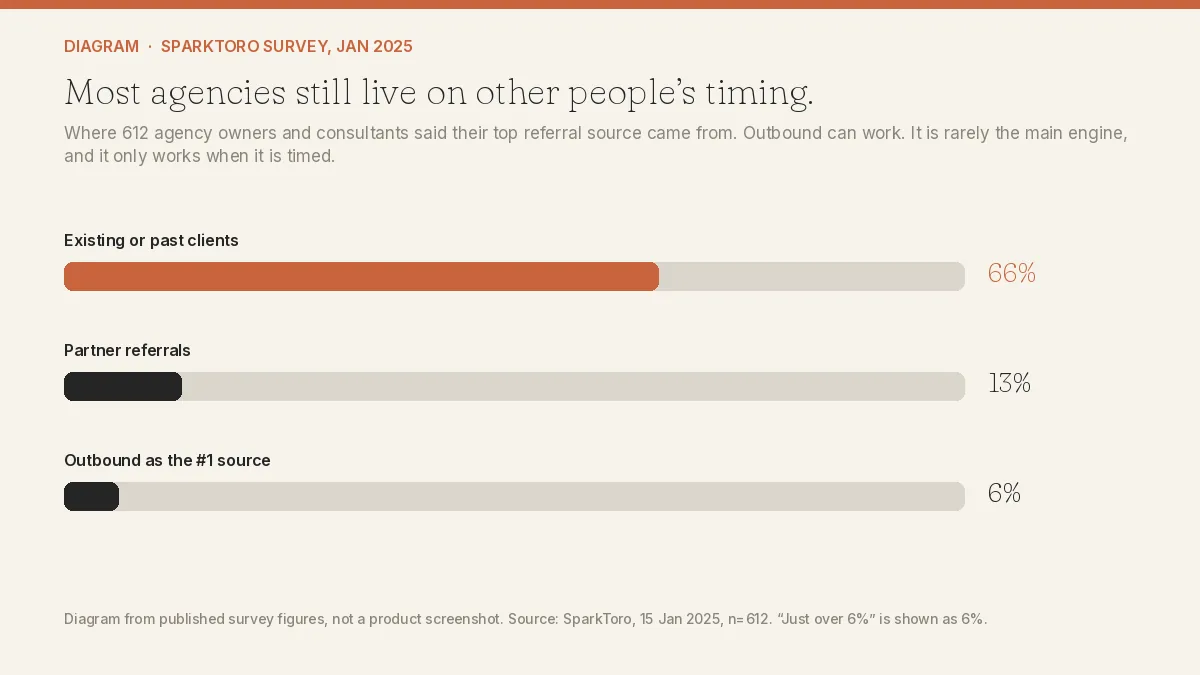
Moogan's reading is the useful one. The positive spin is that a lot of firms must be delivering work worth recommending. The less comfortable spin is that this is a very large reliance on a single source. If you are going to lean on one source, existing clients are the safest. They are still a single source.
The RSW/US 2024 Agency New Business Report, fielded since 2010, lands in the same place. When agencies were asked which three marketing tools had been most effective at generating new business over the past year, the top four were referrals, business from existing clients, networking, and conferences, repeating the previous year's pattern, with a 10-point drop in networking and 5-point upticks in referrals and business from existing clients (RSW/US 2024 Agency New Business Report).
So the "how" is not a mystery. Warm relationships still do most of the work. The question is why so many firms still feel stuck.
Why it still feels harder than it should
In that same RSW/US report, 48% of agencies said obtaining new business had been harder or a lot harder than the previous year (38% harder, 10% a lot harder). 36% said it was the same. 17% said it was easier. 0% said it had been a lot easier. The "harder" share was down from the year before, for the first time since 2021, but it was still the largest group (RSW/US).
The two leading reasons, described in the report as tied at the top, were fewer opportunities out there and harder to break through to prospects. Smaller prospect budgets remained a hurdle, though that share had declined from 59% in 2021 to 46% in 2024. Prospects going dark after early meetings is called out as a familiar frustration. And on timing: "The majority of deals still take up to six months to close."
Moogan's survey adds the pipeline picture. New business sales was, by a decent margin, the biggest challenge respondents expected in the coming year. Most agencies said their sales pipeline was worth up to 25% of their revenue. After a moderate close rate and normal churn, he wrote, that "doesn't seem like an overly healthy picture for most agencies right now" (SparkToro).
This is the feast-or-famine pattern in data form. When you are full, you stop looking. When a client leaves, you start looking. By then, the brands that would have hired you already hired someone who was in the room earlier.
Outbound is not failing because agencies are lazy
Sixty percent of the SparkToro respondents said they had carried out outbound sales activity, higher than Moogan expected. He suspects many of those trials were outsourced lead-generation firms rather than a built in-house function. Of the agencies that had tried outbound, only 10% said it had been very effective. Over half said it had been moderately effective. 34% said it had not been effective at all (SparkToro).
That is not an argument against outbound. It is an argument against untimed outbound.
A templated sequence, sent to a list of "marketing leaders at brands in our ICP," arrives when those people are not in a review, do not have budget, or already have an agency. You did not have a lead problem. You had a when problem. The same message, sent because a brand just started revisiting your case studies, just posted a CMO role, or just told you "not this quarter" six months ago, is a different motion. We unpack those cues in Buying signals: how to tell a brand is ready to hire your agency.
RSW/US also found that only 32% of firms had hired a full-time new business hunter, director, or manager in the past three years, back to 2020 and 2021 levels (RSW/US). Moogan found that full-time sales and marketing hires become much more common as firms grow, with a tipping point around 26+ people for full-time marketing staff (SparkToro). If you are smaller than that, you do not have a department. You have a founder, a thin week, and a temptation to buy a list.
Buy the list if you want. It will not tell you who is in the market this week.
A new-business system that is not just "ask for referrals"
Keep the things that already work. Then add a timing layer around them.
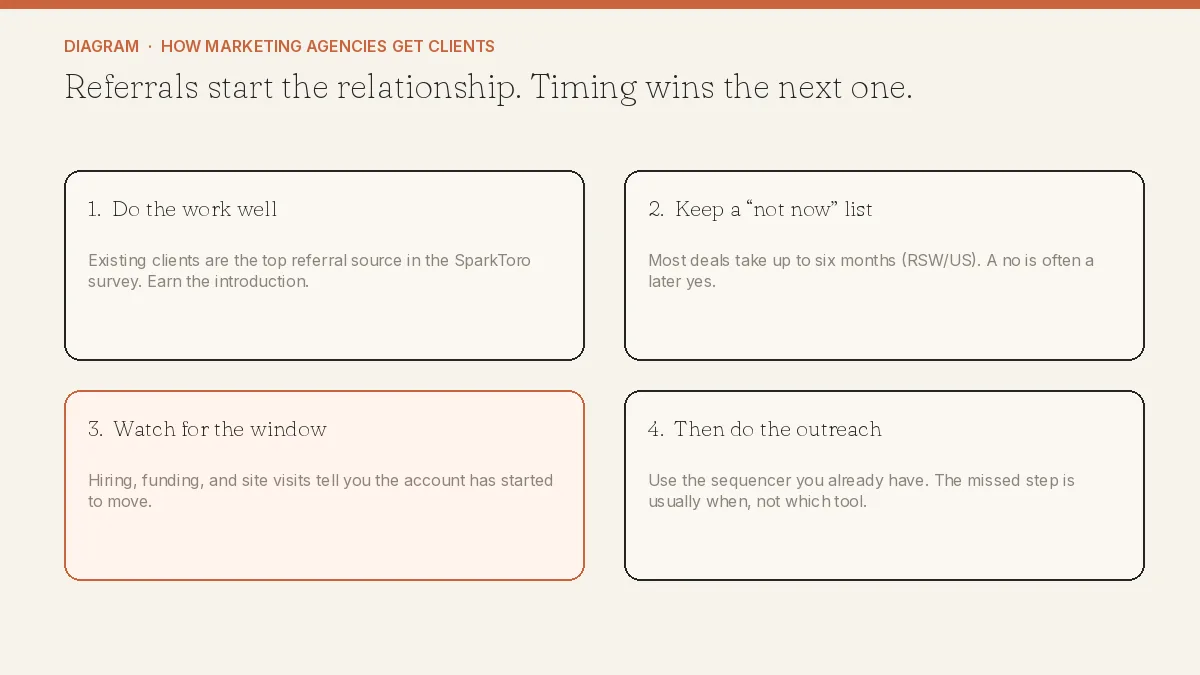
1. Make referrals a habit, not a hope
Existing and past clients are already your top source. Do not wait for them to think of you. After a measurable win, ask for a specific introduction, not "if you hear of anyone." Partner firms in adjacent disciplines (the 13% Moogan flagged as underused) are the same idea at a slightly larger scale.
A referral is often a buying signal in disguise. Someone asked for a name because a decision is already in motion. Treat it that way: move quickly, and do not make the referrer do your selling.
2. Stay in the rooms where "not now" turns into "now"
Networking and conferences still show up in RSW/US's top four. The value is rarely the badge scan. It is the conversation you can honestly follow later, when the brief appears. Most agencies flame out on follow-up, which is rational if follow-up means a monthly "just checking in." Follow the account's timing instead: a leadership change, a launch, a contract end, a return visit to your work.
The Nike marketing strategy teardown is the long form of this idea. Wieden+Kennedy was already doing small work when Nike decided to go national. The review, when it came, was not the beginning of the relationship.
3. Use outbound only when you have a reason to talk this week
Write a short, specific note tied to a real moment: they spent time on a relevant case study, they announced a new marketing lead, they asked for a deck last year and went quiet. Then send it through whatever sequencer you already like. The tool is not the strategy. Instantly, lemlist, Smartlead, Apollo, Outreach, and the rest will send on any Tuesday. ProspectDesk's job, if you use us, is to help you pick the Tuesday. That pairing is laid out tool by tool in Lemlist alternatives for agency outbound.
Do not outsource the "why now" to a vendor who only has a list.
4. Watch your own site as if it were a receptionist
The warmest inbound you will get this month may already be on your website, unnamed. A brand that comes back to a case study is closer to a conversation than a cold title in a database. Website visitor identification and visitor tracking are how you see that without guessing. B2B intent data providers can add earlier, account-level research signals. Neither replaces a referral. Both can tell you when to pick up the phone.
5. Plan for a six-month close, and a thin pipeline
RSW/US says the majority of deals still take up to six months. If your visible pipeline is only a quarter of revenue, you cannot start hunting when a client resigns. New business has to run while you are busy, which is the opposite of how most small firms staff it. That is a capacity issue as much as a sales issue, and it is the subject of How to scale a digital marketing agency.
The timing lesson for agency owners
Agencies don't have a lead problem. They have a timing problem.
Referrals work because they tend to arrive when a buyer is already in motion. Outbound fails when it arrives at a company that is not. Inbound feels "lucky" when someone happens to find you in the week they are allowed to hire. The system underneath all three is the same: be visible, and useful, at the moment a decision opens.
ProspectDesk is built for that moment. We are not a contact-data provider, and we will not pretend a bigger list of CMOs is a new-business program. We show you which companies are actually in-market right now, starting with the people already on your site and the accounts already showing intent, so the next email, referral ask, or conference follow-up happens while a decision is still open. If you sell this kind of motion under your own brand, there is also white-label lead generation software.
If you want to see which of your prospects are in that window, book 30 minutes.
I've taken businesses from $0 to $2M three times, and I built DTC POD and Castmagic along the way. I also built and sold trend.io, which partnered with Pharrell. Every one of those runs was less about finding "enough" people and more about being in the right conversation at the right time.
FAQ
How do marketing agencies get clients?
Most still get them from referrals and from existing or past clients, then from networking and conferences. That is what agencies themselves report in the RSW/US 2024 new-business survey and in SparkToro's survey of 612 agency owners and consultants. Outbound is widely tried and much less often described as very effective.
What is the most effective way for a digital marketing agency to get clients?
There is no single channel that replaces the others. The pattern that holds up is warmth plus timing: ask for specific introductions after a win, stay close to "not now" accounts, and only run outbound when you have a reason to talk this week. A list without a moment is just noise.
Why is agency outbound so often ineffective?
Because it is usually aimed at a fit, not at a moment. The SparkToro survey found that only 10% of agencies that had tried outbound called it very effective. The message may be fine. The Tuesday is wrong.
How long does it take an agency to close new business?
In the RSW/US 2024 report, the majority of deals still take up to six months to close. Plan capacity and follow-up around that, not around a two-week burst of hunting.
Should a small agency hire a new business director?
Only 32% of firms in the RSW/US 2024 survey had hired a full-time new business hunter in the past three years. Full-time marketing hires become much more common around 26 people in Moogan's survey. Before that, a founder-led system with a real timing habit usually beats a hire you cannot keep busy.
Sources
- SparkToro, The State of Digital Agencies in 2024: Client Referrals Drive Agency New Business, 15 Jan 2025, Paddy Moogan, survey of 612 agency owners and consultants
- RSW/US 2024 Agency New Business Report