How to Scale a Digital Marketing Agency (Without the Feast-or-Famine Cycle)
Most digital marketing agencies do not stall because the work got worse. They stall because growth and delivery are sharing the same calendar, and the calendar only has room for one of them at a time.
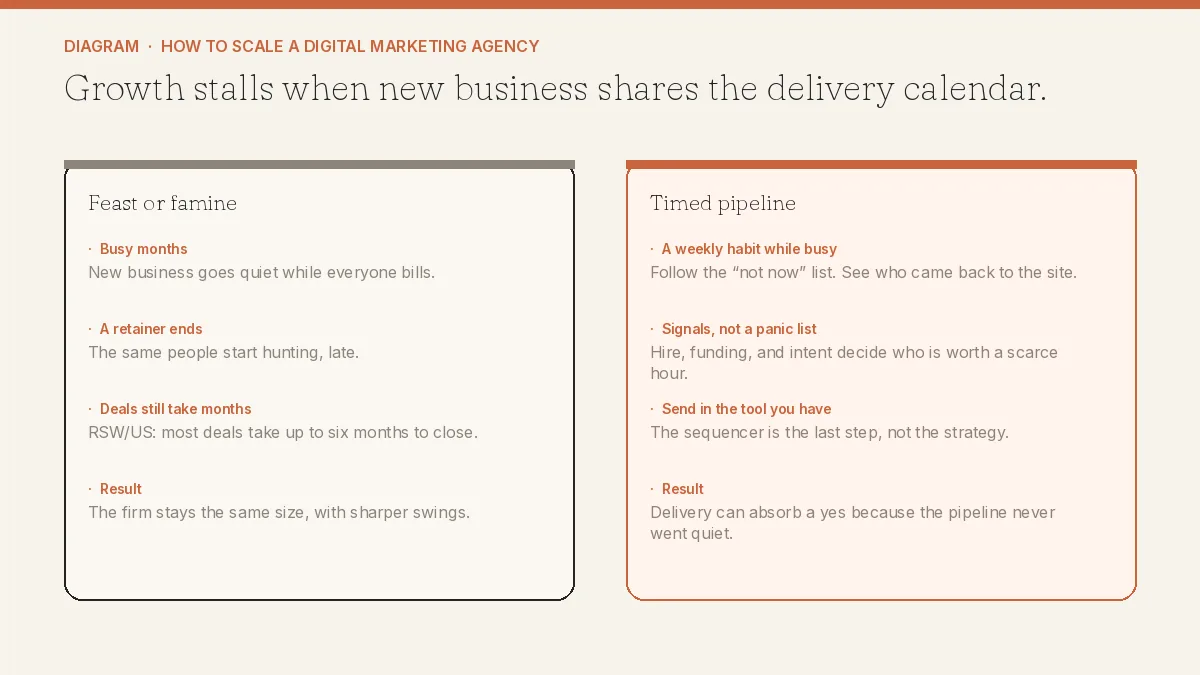
When you are full, new business goes quiet. When a client leaves, everyone who can bill starts hunting. By then, the brands that would have hired you already hired someone who was paying attention earlier. That is not a lead problem. It is a timing problem, and it is the thing that keeps a good firm at the same size for years.
This is a guide for agency owners who want to scale the firm, not just fill the next hole in the roster.
What "scale" actually has to mean
Scaling a digital marketing agency is not the same as adding a couple of freelance specialists. It means you can take on more of the right work without the founder becoming the bottleneck, without quality falling over, and without revenue snapping back when one retainer ends.
Three constraints show up together, whether or not you have named them:
- Capacity. Who can do the work, at what utilization, without nights and weekends becoming the plan.
- Demand. A pipeline that is still moving while you are busy.
- Shape of the work. Productized offers and retainers are easier to staff than a constant stream of one-off projects. One-off projects are easier to win in a panic.
If you only fix capacity, you get a bigger team waiting for work. If you only fix demand, you get a founder who is back in every sales call. If you only productize, you get a neat package that nobody is in the market to buy this month.
The pipeline problem hides inside "we're growing"
In a SparkToro survey of 612 agency owners and consultants, published in January 2025, most agencies said their sales pipeline was worth up to 25% of their revenue. Paddy Moogan, who ran the survey, wrote that after a moderate close rate and ordinary churn, that "doesn't seem like an overly healthy picture for most agencies right now." New business sales was, by a decent margin, the biggest challenge they expected in the coming year (SparkToro, 15 Jan 2025).
The RSW/US 2024 Agency New Business Report adds the close-time reality: "The majority of deals still take up to six months to close." In the same survey, 48% of agencies said obtaining new business had been harder or a lot harder than the year before, and only 32% had hired a full-time new business hunter, director, or manager in the past three years (RSW/US 2024 Agency New Business Report).
Put those together and the scaling math is unforgiving. If a hire takes months to pay for itself, and a new client takes months to close, you cannot start both clocks when a retainer is already on its way out.
Moogan also found that existing and past clients were the top referral source for 66% of respondents. That is a strength until it is the only engine. A firm that scales on referrals alone is scaling on other people's timing. When those introductions slow, growth looks like a mysterious stall. It is usually just a quiet pipeline.
The longer version of how to build the demand side is in How marketing agencies get clients. The short version, for scale, is this: new business has to run on a clock that does not care whether this week is a delivery week.
Hire later than you think, and earlier than the crisis
Moogan's data has a clear pattern: as agencies get larger, they are more likely to have full-time sales staff and full-time marketing staff. The tipping point he flags for a full-time marketing hire is around 26+ people, where more than half of agencies say they have one (SparkToro). Before that, most firms are choosing between a marketer for the agency and another delivery hire.
That choice is real. A full-time hunter you cannot keep busy is an expensive way to learn that your offer, your ICP, or your timing is still fuzzy. A delivery hire with no pipeline behind them is how you create idle cost.
A practical order that respects both constraints:
- Write down the work you will sell more of. If every new client is a custom invention, you cannot staff ahead of it. A clearer offer, even if it is just "the first 90 days look like this," is a scaling tool.
- Put a weekly new-business habit on the calendar while you are busy. Not a quarterly offsite. A short, repeating block: follow the "not now" list, look at who has been on the site, ask for one specific introduction.
- Hire delivery when the work is repeating. Hire sales or marketing for the firm when the founder is the only person who can start a conversation, and when there is already a motion worth handing off.
Do not hire a new-business director to "fix leads" if the real issue is that outreach lands when nobody is buying. Train the motion first. Then give it to someone.
Capacity: stop using the founder as overflow
The unglamorous part of scaling is utilization. If the founder is still the senior strategist, the closer, the emergency designer, and the person who answers the "do you have 15 minutes?" texts, the firm has a ceiling. It just has not hit it yet.
You do not need a benchmark from a blog to see this in your own week. If the only way a new retainer gets delivered is by you stepping in, you have not scaled delivery. You have scaled your hours. The fixes are boring and they work:
- A default way the work runs. Scopes, QA, and weekly reporting that a lead can run without reinventing them.
- A bench you can actually use. Freelancers or a partner for peaks, so a new yes does not automatically mean a new salary.
- A honest no. Taking work you cannot staff is not growth. It is how you lose the clients you already have.
Retainers help only if the delivery is repeatable. A retainer that is really a bundle of undefined projects will still blow up your calendar. Productized offers help only if they match what buyers are trying to get done. Neither one removes the need for timed new business. They just make a win easier to absorb.
If you resell a lead or identification product under your own brand as you grow a services line, the buying questions are different from a tool you use internally. That is covered in white-label lead generation software.
Time the next yes so delivery can breathe
This is the part most "how to scale an agency" articles skip, because it sounds like sales, and sales sounds like a different department.
Scaling requires a view of when accounts are in motion, not just a list of accounts that look like your ICP. A brand that is on your case studies this week, that just posted a CMO role, or that told you "not until the spring" last autumn is a better use of a scarce founder hour than a 200-row export. Those cues are buying signals. Seeing the people already on your site is website visitor identification. Earlier, account-level research signals are covered in B2B intent data providers.
When you do reach out, use the sequencer you already have. Instantly, lemlist, Smartlead, Apollo, Outreach, Salesloft, and the rest are good at sending. They will not tell you whether this is the week to send. ProspectDesk is the timing layer: it helps you decide who is in-market, and then you run the sequence in the tool your team already knows. The honest comparison of those tools is in Lemlist alternatives.
The point of all of this is not more activity. It is fewer, better-timed conversations, so the work you already sold has room to be done well.
The timing lesson for agency owners
Agencies don't have a lead problem. They have a timing problem.
A firm scales when new business keeps moving during the busy months, when delivery can absorb a yes without the founder becoming the overflow plan, and when "growth" is not a synonym for "we got lucky with referrals this quarter." The Nike, Liquid Death, and Duolingo teardowns in this series are about brands. The lesson for you is the same: the agency that is already useful when the decision opens is the one that gets the work.
ProspectDesk is built for that. We are not a contact-data provider, and we are not a substitute for a clear offer or a real delivery system. We show you which companies are actually in-market right now, starting with the people already on your site and the accounts already showing intent, so the next conversation happens while you still have the capacity to honor it.
If you want to see which of your prospects are in that window, book 30 minutes.
I've taken businesses from $0 to $2M three times, and I built DTC POD and Castmagic along the way. Each time, the ceiling was not a shortage of people to talk to. It was whether we were talking to them when they were ready, and whether we could deliver when they said yes.
FAQ
How do you scale a digital marketing agency?
You scale it by moving three things together: a repeatable way to deliver the work, a pipeline that still moves while you are busy, and an offer you can staff more than once. Hiring only one of those sides, or hunting for clients only when a retainer ends, is how firms stay the same size.
When should an agency hire a salesperson or a marketer for the firm?
In SparkToro's survey of 612 agency owners and consultants, full-time marketing hires become much more common around 26 people. The RSW/US 2024 report found that only 32% of firms had hired a full-time new business hunter in the past three years. Hire after you have a motion worth handing off, not as a substitute for one.
How big should an agency's pipeline be?
There is no universal ratio. In Moogan's survey, most agencies said their pipeline was worth up to 25% of revenue, which he flagged as thin once you apply a close rate and churn. Because most deals in the RSW/US report still take up to six months to close, a pipeline you can only see this month is not a scale plan.
Do retainers help an agency scale?
They can, if the work inside the retainer is repeatable and scoped. A retainer that is really an undefined pile of projects will still consume the founder. Retainers also do not replace timed new business. They just make a win easier to deliver.
Is scaling just about getting more leads?
No. More untimed leads make the feast-or-famine cycle louder. Scaling is more work, delivered well, from a pipeline that does not go quiet when you are busy.