Netflix Marketing Strategy: How Netflix Knows Its Prospect Before the Ad Runs (and What Agency Owners Should Steal)
Most Netflix case studies are about the shows: the recommendation engine, the thumbnails, the binge. This one is about the other side of the screen. Since 2022, Netflix has been building an advertising business, and the way it decides who sees an ad, when, and how it proves the ad worked is the most useful sales lesson an agency owner can get from a streaming company.
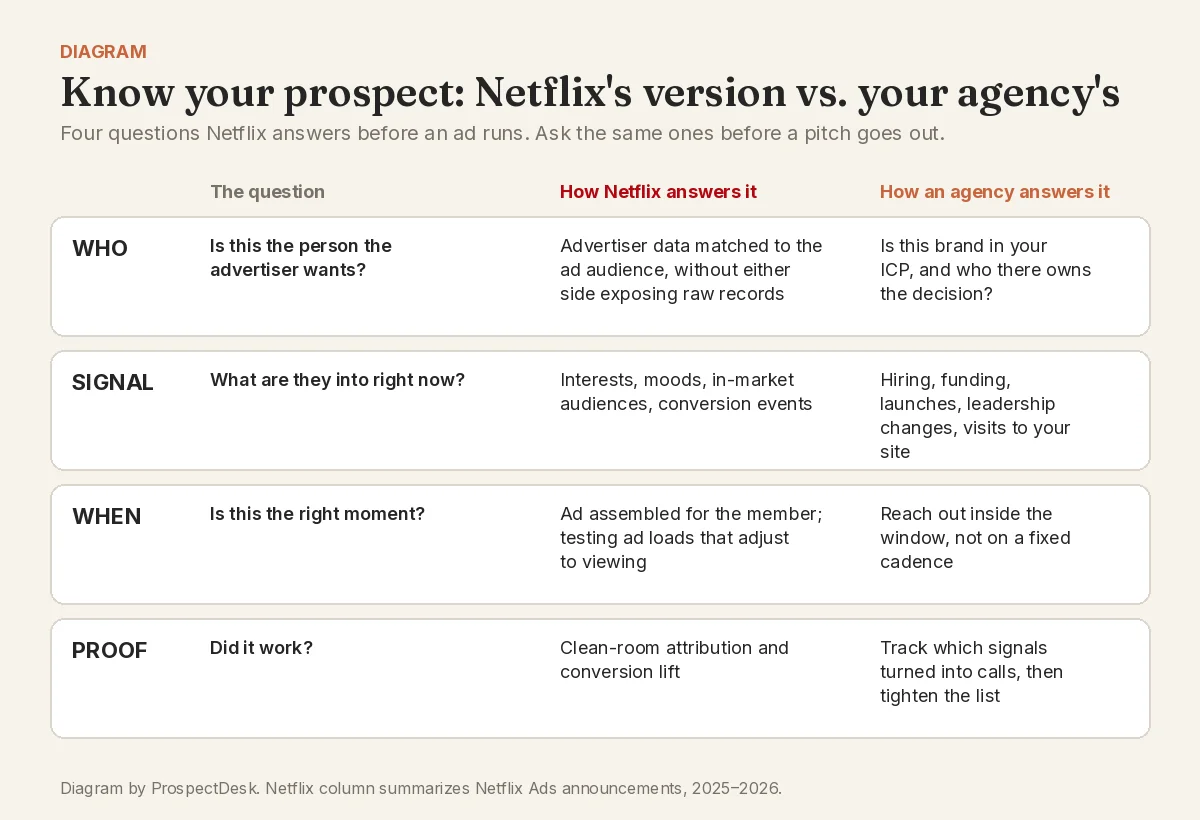
Here is the short version. Netflix's ad business is a know-your-prospect machine. Before an ad runs, Netflix wants to answer four questions: who this person is, what they are signaling right now, whether this is the moment, and whether the result can be proven without anyone handing over raw customer data.
Agencies run the same four questions every time they chase a new client. Most just answer them badly, or answer only the first one. That is why the theme of this series holds here too: agencies don't have a lead problem, they have a timing problem. And timing is what you get once you actually know your prospect.
This teardown is written for agency owners. The agency is the hero, too: one of the clearest proof points in Netflix's data story came from a performance agency that insisted on measurement before it would treat Netflix like a serious channel.
Listen on DTC POD: #245 - Chelsea Schulz, Ettitude: Data Driven Performance & Growth. Chelsea joins Blaine and Ramon for a crash course on growth: setting up a growth engine, working from a single source of truth, how to think about metrics, and keeping acquisition and retention in step. It is the same discipline Netflix applies at a much larger scale. Also on Apple Podcasts.
The numbers behind Netflix's ad business
Start with scale, because it explains why Netflix cares so much about knowing exactly who is watching.
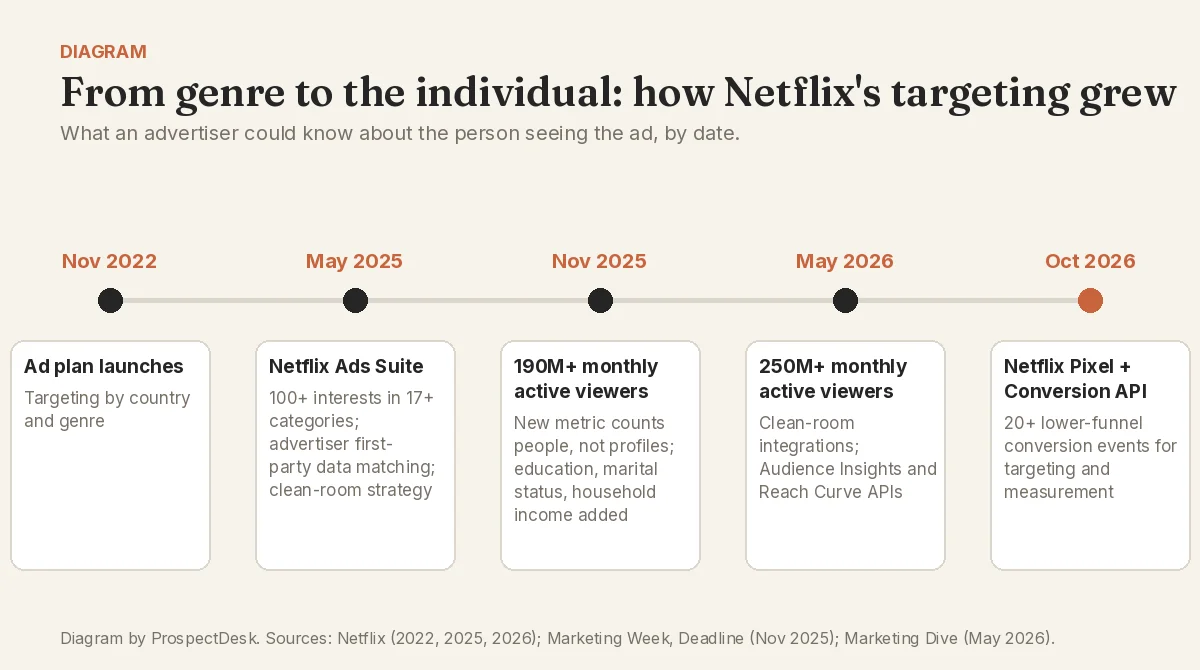
- Netflix's ad plan launched on 3 November 2022 at $6.99 a month in the US, in 12 countries. At launch, advertisers could target "by country and genre (e.g. action, drama, romance, sci-fi)" (Netflix, 13 Oct 2022).
- By May 2025, Netflix reported more than 94 million global monthly active users on the ad plan (Netflix, 14 May 2025).
- In November 2025, it switched to a new metric, monthly active viewers (members who watched at least one minute of ads in a month, multiplied by Netflix's estimate of people per household), and reported more than 190 million (Reuters, 5 Nov 2025).
- At its May 2026 Upfront, Netflix put the figure at more than 250 million monthly active viewers, said over 60% of sign-ups were choosing the ads plan, and announced 15 new ad markets for 2027 (Variety, 13 May 2026; Deadline, 13 May 2026).
- In its Q3 2026 shareholder letter, Netflix said it now expects 2026 ad revenue of about $2.7 billion, down from about $3 billion, "due to slightly slower than expected rollout of some ad product capabilities" (Netflix Q3 2026 letter, SEC filing).
Two caveats are worth keeping in mind. The viewer numbers are Netflix's own, built from its first-party household research rather than a third-party count, as Variety pointed out. And the forecast cut shows that even Netflix is still building this machine. That second point matters for agencies: the business is growing, and the data capabilities are what's holding up the timeline. The data is the strategy.
Why Netflix is really a "know your prospect" company
Netflix started in ads with country and genre targeting. That is roughly where most agencies still are with new business: "DTC brands in the US," "B2B SaaS, Series A to C." It is a category, not a prospect.
Netflix's own people describe the goal very differently. In a 2026 customer-story video published by one of its data partners, Jon Whitticom, then Netflix's VP of Ads Product, explained the starting point (Whitticom left Netflix in August 2026, according to Business Insider):
> "Netflix overall mission is to entertain the world, and that's a pretty big aspiration. And it requires us to know our members, their interests, their habits, their dreams, their desires, their mood states, and figure out the right entertainment option for them."
Then he applied the same idea to ads. Two people in one household, he said, should not get the same ad experience:
> "A husband or wife in different rooms watching different TVs or on different form factors will actually have a very different experience despite the fact they're in the same household because we want it to be a very deep personalized experience just like with our content."
That is know-your-prospect in one sentence. Not the account. Not the household. The person, in the moment.
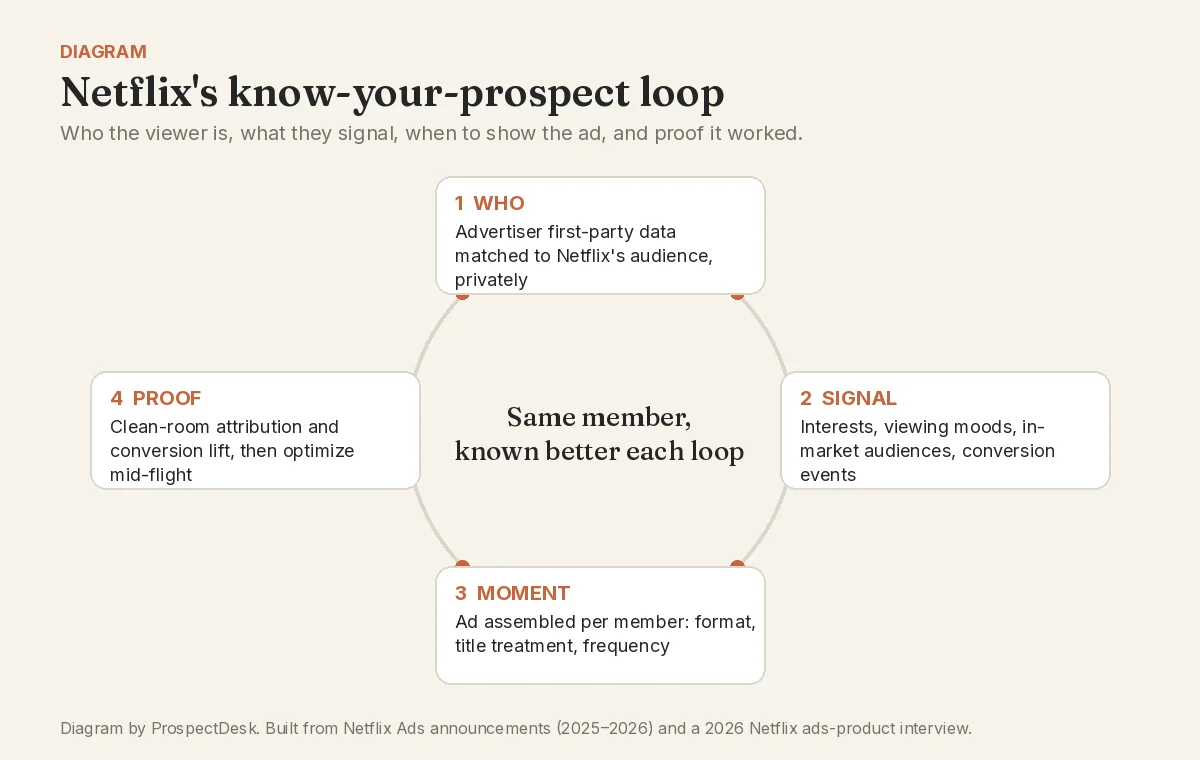
How Netflix uses prospect data, step by step
Step 1: Who. Match the advertiser's customers to the audience, without exposing anyone
The first question any advertiser asks is simple: are my people watching Netflix?
When Netflix launched its in-house ad platform, the Netflix Ads Suite, in 2025, the answer became something advertisers could test with their own data. Netflix said advertisers could "now incorporate their first-party data," either through an identity partner "or directly with Netflix, so clients can match data sets for behavioral insights and targeting capabilities against Netflix's ads audience." It also "announced our own clean room strategy, where we can collaborate in a private, secure environment on everything from planning and activation to measurement. All while protecting the privacy of our members" (Netflix, 14 May 2025).
In plain English, a data clean room is a shared, locked environment. The brand brings its customer list. Netflix brings its audience. The software finds the overlap and answers agreed questions, such as how many of my customers watch, what they watch, and whether the ones who saw my ad bought. Neither side sees the other's raw records.
Netflix kept widening that "who" layer:
- May 2025: "more than 100 interests in over 17 categories, including life stages," plus third-party data access through partners such as Experian and Acxiom (Netflix).
- November 2025: demographic targeting expanded to education, marital status, and household income (Marketing Week, 5 Nov 2025).
- May 2026: clean-room integrations with Snowflake and Amazon Web Services, with InfoSum to follow by the end of the year, plus a new Audience Insights API to help advertisers learn about member characteristics and behavior (Marketing Dive, 14 May 2026).
- September 2026: at DMEXCO in Cologne, Netflix Ads' German team announced another clean-room partnership starting in 2027, part of widening privacy-safe collaboration across its ad markets.
The video interview names the role these partners play. Netflix described identity and onboarding partners as the "entry path" for advertiser data, and said it works "with cleanroom partners to make sure that we can understand are we seeing activation against these exposures and that the advertiser's data is safe as well."
The agency version: You can't match a customer file against anyone's audience. You can, though, stop treating "who" as a category. Name the companies that actually fit, find out who owns the decision at each one, and confirm the company is real, active, and reachable before anyone writes a first line.
Step 2: Signal. Know what the prospect cares about right now
"Who" tells you whether someone fits. "Signal" tells you whether they are paying attention.
Netflix's own programmatic guide lists the signals it sells against. Under Netflix targeting: interests, viewing moods, advanced demographics, and in-market audiences. Under content: genre, Top 10, and title selection. Under viewing experience: first impression, ad pod, daypart, device, and language. Advertisers can add their own first-party audiences and "expansion audiences" on top (Netflix Ads, 28 Sep 2026).
Then, in October 2026, Netflix moved the signal down the funnel. It enhanced its Conversion API and built a Netflix Pixel so advertisers can send "more than 20 lower-funnel conversion events" in a standardized way, and use them both to measure results and to "build audience segments based on their conversion data" (Netflix, 20 Oct 2026).
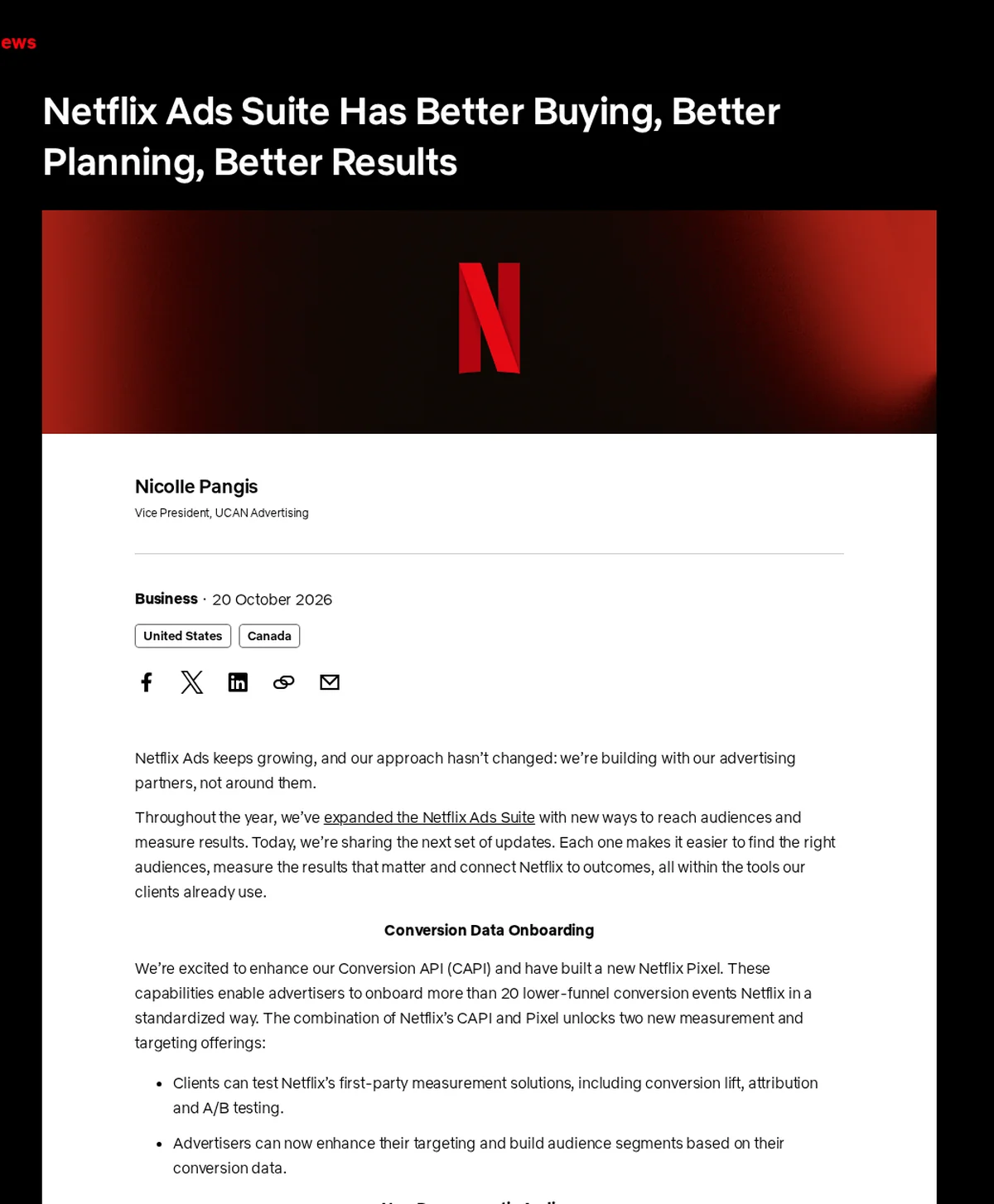
The pattern is worth noticing. Netflix didn't stop at knowing what people like. It went after what they do: site visits, add-to-carts, sign-ups. A behavior is worth far more than a profile.
The agency version: Your prospects broadcast signals all the time. They hire a new head of marketing. They raise a round. They launch a product or move into a new market. They post a role your agency would fill. They visit your case studies twice in a week. Each of these is a conversion event in someone else's funnel, and a reason to talk in yours. We cover the full list in buying signals: how to tell a brand is ready to hire your agency.
Step 3: Moment. Put the right message in front of the right person at the right time
This is where Netflix's approach gets ambitious. In the video, the ads-product lead described members seeing different title treatments, ads with "pieces of Netflix content" infused into them, and "completely different interactive formats that are meant to both bring the engagement, bring brand relevancy, and create delight."
The public record backs that up:
- In May 2025, Netflix said it was using generative AI to "marry advertisers' ads with the worlds of our shows," and showed interactive midroll and pause formats with overlays, calls to action, and second-screen buttons, designed "to serve the right ad to the right member at the right time" (Netflix).
- In May 2026, Netflix said it was testing "personalized ad loads and frequency caps that dynamically adjust the ads a member sees based on their viewing behaviors," plus AI agents to help advertisers buy and adapt creative (TheWrap, 13 May 2026).
The video also explains why Netflix bothers. "In a world where we're able to actually automate the overall assembly of the media plan and really drive it down to almost the individual level," Whitticom said, "we're seeing much higher performance and seeing a member that's consuming more ads and spending more time with us." Netflix hasn't put a public number on "much higher performance" in that video, so take it as a direction, not a statistic.
The agency version: The moment is the whole game. Brands don't hire agencies on your schedule. They hire when something changes: a new CMO, a missed quarter, a launch date, an in-house team that just lost its lead. A great pitch sent three months early gets "not now." The same pitch sent the week after the signal gets a call.
Step 4: Proof. Close the loop, then use it to know the prospect better
The last piece is measurement, and it's where an agency steps into the story.
Netflix's Ads Suite now includes first-party brand lift, attribution, and conversion lift, and it brings measurement into the tools buyers already use. Netflix says Yahoo DSP advertisers can measure single-publisher attribution across their Netflix buys, with The Trade Desk to follow (Netflix, 20 Oct 2026). In the same post, Netflix said its conversion-lift measurement showed a leading delivery app a +2.7% lift in sign-ups and a 2.9% lift in new trials, numbers that "help separate true lift from conversions that would have happened anyway."
That phrase, "conversions that would have happened anyway," is the honest heart of measurement. A good clean room doesn't just count who bought. It tells you who bought because of the ad. Then the result feeds back into step one: you know more about who the real prospect is.
The agency that made Netflix prove it: Tinuiti
Here's the part of the story built for agency owners.
Tinuiti is a performance media agency. According to Netflix's own case study, it "seeks to hold every media partner to the same standard: clear, defensible, lower-funnel performance measurement." Netflix was a premium, culture-heavy channel. Tinuiti wanted proof that it converts.
So the two integrated a data clean room where "Netflix ads exposure data and Tinuiti's conversion data, like website visits and add-to-cart actions, could be securely matched without either side exposing sensitive user-level information." They ran a pilot on historical campaign data across three Tinuiti-managed brands, in education, fitness/DTC retail, and financial services, and compared Netflix against Tinuiti's own cross-platform conversion benchmarks (Netflix Ads case study).
The results, as Netflix reports them:
- Netflix campaigns met or exceeded Tinuiti's conversion benchmarks 77% of the time.
- Education brand: 57% above the monthly purchase benchmark.
- Fitness brand: 16% above the monthly add-to-cart benchmark.
- Financial services brand: 106% above the average activation benchmark.
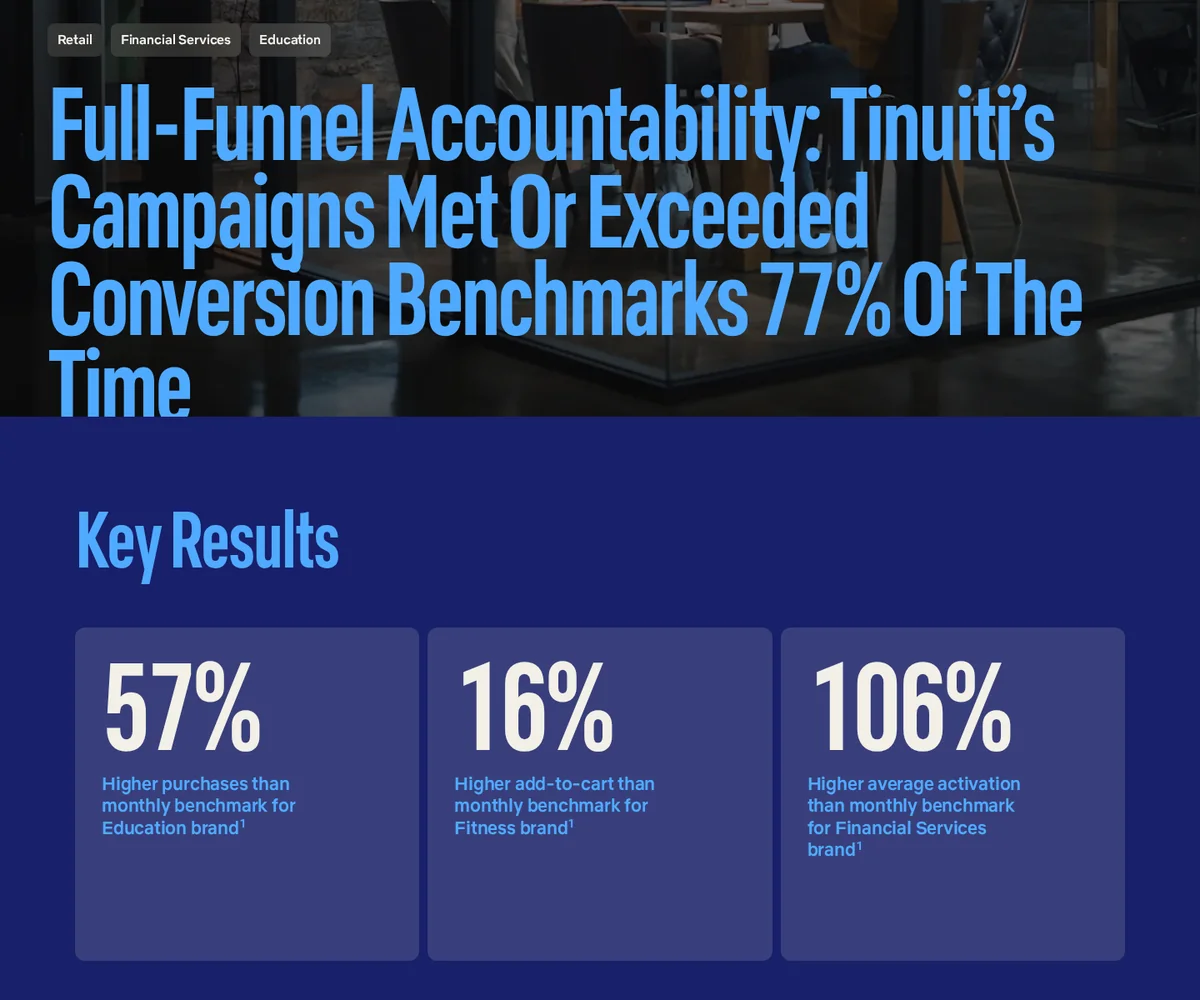
Keep in mind that this is a vendor's case study about its own channel, built on three brands and historical data. It's a good result, not an independent audit.
What makes Tinuiti the hero isn't the 77%. It's the position Tinuiti took. The agency didn't wait for Netflix to hand it a deck. It set the bar (prove conversions, privately, against our benchmarks), helped build the method, and walked away with a "repeatable, portfolio-wide" framework it can use across clients. By May 2026, Marketing Dive listed Tinuiti alongside Dentsu, Horizon, Omnicom, and PMG as agencies Netflix works with on planning APIs and clean rooms (Marketing Dive).
That's an agency that knew its prospect, and its client's prospects, better than the platform did, and showed up while the channel was still proving itself. Early, specific, measurable. Timing.
What agency owners should steal from Netflix
1. Replace your "ICP" with a real prospect
Netflix went from "country and genre" to individual members in about three years. Most agency new-business plans still look like Netflix in 2022: a vertical, a size band, a region.
Steal this: Write down the 50 companies you'd actually want as clients this year. For each one, note who owns the agency decision and what would make them need you. That's a prospect list. A filter on a database isn't.
2. Signals beat profiles
Netflix's biggest recent step wasn't more demographics. It was conversion events: what people did. Your version is the same. A brand that "fits" tells you very little. A brand that just hired a VP of Growth, opened a role you'd fill, or read three of your case studies tells you a lot.
Steal this: Pick five signals that have come right before your best wins, and watch for them every week. How marketing agencies get clients breaks down which ones matter most for agencies.
3. Respect the line on privacy
Netflix built its whole data story on not exposing anyone's raw data: not the advertiser's customers, not its own members. That's a growth choice as much as a legal one. Advertisers bring more data to a partner they trust.
Steal this: Don't scrape, spray, or guess. Make sure a prospect is real, reachable, and cleared to contact before you reach out. Outreach that feels like surveillance kills the relationship before it starts.
4. Make timing a system, not a mood
Netflix doesn't hope the right ad lands at the right time. It assembles the ad when the member shows up. Agencies, meanwhile, run new business in bursts, usually when the pipeline is already empty. That's the feast-or-famine cycle in how to scale a digital marketing agency.
Steal this: Check signals every week, even when you're fully booked. The time to start a conversation is when the signal fires, not when you have capacity.
5. Prove it, then let proof pick your next prospect
Tinuiti's pilot didn't just justify Netflix spend. It told Tinuiti which kinds of brands, in which categories, Netflix works for. That's a better prospect list for next year.
Steal this: Track every new-business conversation back to the signal that started it. After a quarter, you'll know which signals produce calls and which produce "not now." Cut the second kind.
6. Be the agency that shows up while the platform is still proving itself
Netflix's ad business is still young enough that it cut its own revenue forecast while it builds. Agencies that lean in during phases like this, the way Tinuiti did, end up with the frameworks, the case studies, and the seat at the table. The same goes for your prospects. The best time to meet a brand is while it's still figuring things out, not after it has picked a partner.
Where ProspectDesk fits
Netflix spent three years and a lot of engineering answering four questions about every ad: who, what signal, what moment, what proof. Agencies need the same answers about every pitch, and they don't have the hundreds of ad engineers Netflix reportedly has to get them.
That's the category ProspectDesk is building in: Know Your Prospect. We aren't another contact-data provider, and we won't sell you a bigger list of marketing directors. ProspectDesk resolves the companies and people already showing interest, including visitors to your own site, and runs a check before anything goes out: is this prospect real, reachable, ready (an in-market signal, recently), and permitted to contact? Then the record goes into the tools you already use, whether that's email, LinkedIn, ads, or your CRM. Like Netflix's version, the point isn't more names. It's the right person, the reason why now, and a send that respects privacy.
If you want to go deeper on the pieces, start with intent targeting, identity resolution software, and website visitor identification. For more brand breakdowns, the rest of the series is in Agency Teardowns, including Duolingo, Nike, and the Red Bull marketing strategy teardown.
If you want to see which of your prospects are in the window right now, book 30 minutes.
I've taken businesses from $0 to $2M three times. I built trend.io (and partnered with Pharrell before we sold it), plus DTC POD and Castmagic. Every run taught me the same thing Netflix is teaching advertisers: the deal goes to whoever knew the prospect and showed up when the moment opened, not to whoever had the longest list.
FAQ
What is Netflix's marketing strategy for its ad business?
Netflix sells advertisers access to an engaged audience, then uses data to decide which member sees which ad and when. Advertisers can match their own first-party data to Netflix's audience, target interests, viewing moods, and in-market audiences, and measure results through brand lift, attribution, and conversion lift, often inside a data clean room.
How does Netflix use first-party data in advertising?
Netflix combines its own member signals (interests, viewing behavior, demographics) with advertisers' first-party data. Since 2025, advertisers have been able to bring their customer data directly or through an identity partner and match it to Netflix's ad audience. Since October 2026, they've also been able to send conversion events through Netflix's Conversion API and Pixel for targeting and measurement.
What is a data clean room, and why does Netflix use one?
A data clean room is a secure environment where two companies can match and analyze their data without either side seeing the other's raw records. Netflix uses clean rooms so advertisers can plan, target, and measure campaigns against Netflix's audience while member and customer data stay protected.
How many people does Netflix's ad tier reach?
At its May 2026 Upfront, Netflix said its ad plan reaches more than 250 million monthly active viewers worldwide, up from more than 190 million in November 2025. Netflix counts a monthly active viewer as a member who watched at least one minute of ads in a month, multiplied by its estimate of people per household.
Did Netflix's advertising work for agencies?
In a Netflix Ads case study, the performance agency Tinuiti used a clean room to match Netflix ad exposure to its clients' conversion data. Netflix campaigns met or exceeded Tinuiti's conversion benchmarks 77% of the time across three brands. The study was published by Netflix and used historical campaign data.
What can agency owners learn from Netflix's data strategy?
Know your prospect before you pitch. Define real target companies, watch for buying signals, reach out when a signal fires, respect privacy, and measure which signals turn into calls. That's the timing advantage Netflix builds into every ad.
Sources
- Netflix, "Netflix Starting From $6.99 a Month," 13 Oct 2022
- Netflix, "Netflix Upfront 2025: The Center of Attention," 14 May 2025
- Reuters, 5 Nov 2025
- Marketing Week, 5 Nov 2025
- Variety, 13 May 2026
- Deadline, 13 May 2026
- TheWrap, 13 May 2026
- Marketing Dive, 14 May 2026
- Business Insider, Aug 2026
- Netflix Ads, "A Gentlemen's Guide To Netflix Programmatic Advertising," 28 Sep 2026
- Netflix, "Netflix Ads Suite Has Better Buying, Better Planning, Better Results," 20 Oct 2026
- Netflix Q3 2026 shareholder letter (SEC Exhibit 99.1)
- Axios, 2 Nov 2026
- Netflix Ads, Tinuiti case study, 2026
- Netflix ads-product interview: a 2026 customer-story video with Jon Whitticom, then VP of Ads Product at Netflix (published by a Netflix data partner)
- DTC POD #245, Simplecast · Apple Podcasts